 Add to Chrome
 Add to Firefox
 Add to Edge
Interdomain Attention: Beyond Token-Level Key-Value Memory
May 23, 2026
Transformers and deep state space models (SSMs) sit at opposite ends of a basic design choice: attention routes each query through a growing key-value (KV) cache by content-based matching at quadratic cost, while deep SSMs compress context into a fixed-size recurrent state that is not directly addressed by query-key matching. We propose Interdomain Attention, which integrates an SSM into an attention module through kernel methods: an attention kernel is approximated by a finite feature map, the resulting key features and values are projected onto a shared set of basis functions maintained by a single SSM recurrence, and each query attends to the compressed coefficients through its own feature map, recovering query-conditioned attention over a fixed-size state. The scalable layer is a learned relaxation of this derivation, and we validate its components through ablations. In a 125M to 1.3B autoregressive language-modeling study on FineWeb-Edu at matched recurrent-state budget, Interdomain Attention improves on an SSM token mixer at every scale, surpasses a same-recipe softmax baseline at 1.3B on validation perplexity and on the eight-task commonsense suite, and inherits the length-flat behavior of its fixed-state core out to 3.5x the training context. Ablations indicate that the query-conditioned projection is the main source of the gain.

Saliency-Aware Regularized Quantization Calibration for Large Language Models
May 07, 2026Post-training quantization (PTQ) is an effective approach for deploying large language models (LLMs) under memory and latency constraints. Most existing PTQ methods determine quantization parameters by minimizing a layer-wise reconstruction error on a predetermined calibration dataset, usually optimized via either scale search or Gram-based methods. However, from the perspective of generalization risk, existing calibration objectives of PTQ based only on empirical reconstruction error on limited or unrepresentative calibration data could move the quantized weights away from the original weights. This may cause the generalization risk to diverge, potentially degrading downstream performance. To address this issue, we propose \emph{Saliency-Aware Regularized Quantization Calibration} (SARQC) a unified framework that augments the standard PTQ objective with a saliency-aware regularization term. This term encourages quantized weights to stay close to the original weights during calibration, leading to improved generalization during inference. SARQC integrates seamlessly into existing PTQ pipelines, enhancing both scale search and Gram-based methods under a unified formulation. Extensive experiments on dense and Mixture-of-Experts LLMs demonstrate consistent improvements in perplexity and zero-shot accuracy, without additional computational overhead during inference.
Recurrent Memory for Online Interdomain Gaussian Processes
Feb 12, 2025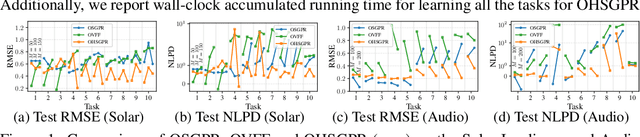
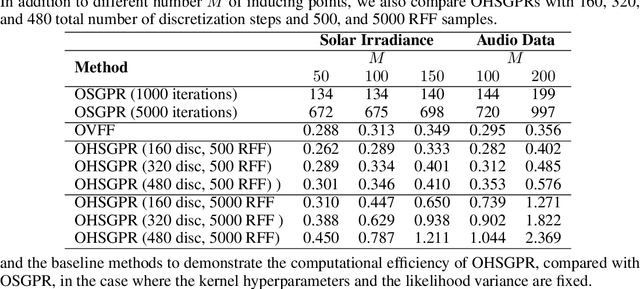
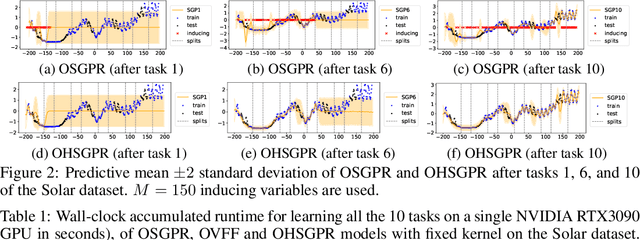
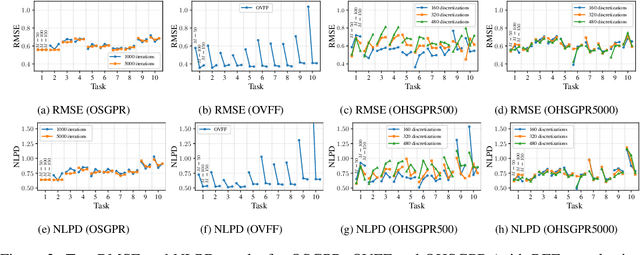
We propose a novel online Gaussian process (GP) model that is capable of capturing long-term memory in sequential data in an online regression setting. Our model, Online HiPPO Sparse Variational Gaussian Process Regression (OHSGPR), leverages the HiPPO (High-order Polynomial Projection Operators) framework, which is popularized in the RNN domain due to its long-range memory modeling capabilities. We interpret the HiPPO time-varying orthogonal projections as inducing variables with time-dependent orthogonal polynomial basis functions, which allows the SGPR inducing points to memorize the process history. We show that the HiPPO framework fits naturally into the interdomain GP framework and demonstrate that the kernel matrices can also be updated online in a recurrence form based on the ODE evolution of HiPPO. We evaluate our method on time series regression tasks, showing that it outperforms the existing online GP method in terms of predictive performance and computational efficiency